Product Catalog
ROCSIL Foam Roof Cavity Recovery on Longwall Faces
Roof cavity recovery on longwall faces: the engineering case for phenolic foam
A roof cavity above the shields is one of the few events that can stop a longwall face for days. Filling the void with an expansive phenolic foam has become the standard recovery method in coal longwalls because it addresses the mechanics of the problem: it confines broken ground, restores canopy contact and removes people from beneath unsupported roof. This article sets out how cavities form, what the foam actually does, how it is applied and where its limits lie.
By Anthony Ferrenbach, General Manager Americas, Weber Mining & Tunnelling
1. How a roof cavity forms on a longwall face
A longwall shield only works while its canopy is in contact with the roof. The design leaves a short unsupported span between the canopy tip and the coal face; the immediate roof over that span is expected to stand on its own for the time it takes the shearer to pass and the shield to advance. A cavity forms when it does not. The immediate roof fails between the tip and the face, or ahead of the face after a spall, and once the first block falls the effective span grows to several metres. The failure then propagates upwards until it either reaches a competent bed or forms a self-stable arch. What is left is a void above the canopy line, a pile of rubble on the armoured face conveyor (AFC) and a group of shields with nothing to set against.
The usual triggers are well documented: weak or laminated immediate roof (mudstone, carbonaceous shale, coal roof); fault, dyke or slip crossings; friable coal that spalls and lengthens the tip-to-face distance; delayed advance or low hydraulic pressure that leaves the roof unconfined for too long; and high horizontal stress that produces guttering at the face corner. Deeper faces meet more of these conditions, and the consequences of a fall scale with depth and abutment load.
The critical point for recovery is that a cavity is not a static defect. Shields without roof contact cannot generate setting load, the adjacent shields become overloaded, and the exposed roof around the void continues to deteriorate with time. As the face advances, the cavity tends to migrate along the face with it. Every hour between the initial fall and the completion of a competent fill increases the volume to be recovered and the tonnage that will end up on the AFC. Recovery is therefore a race against time-dependent deterioration, and the method chosen has to be judged on the time it takes to establish confinement, not only on the strength of the final product.
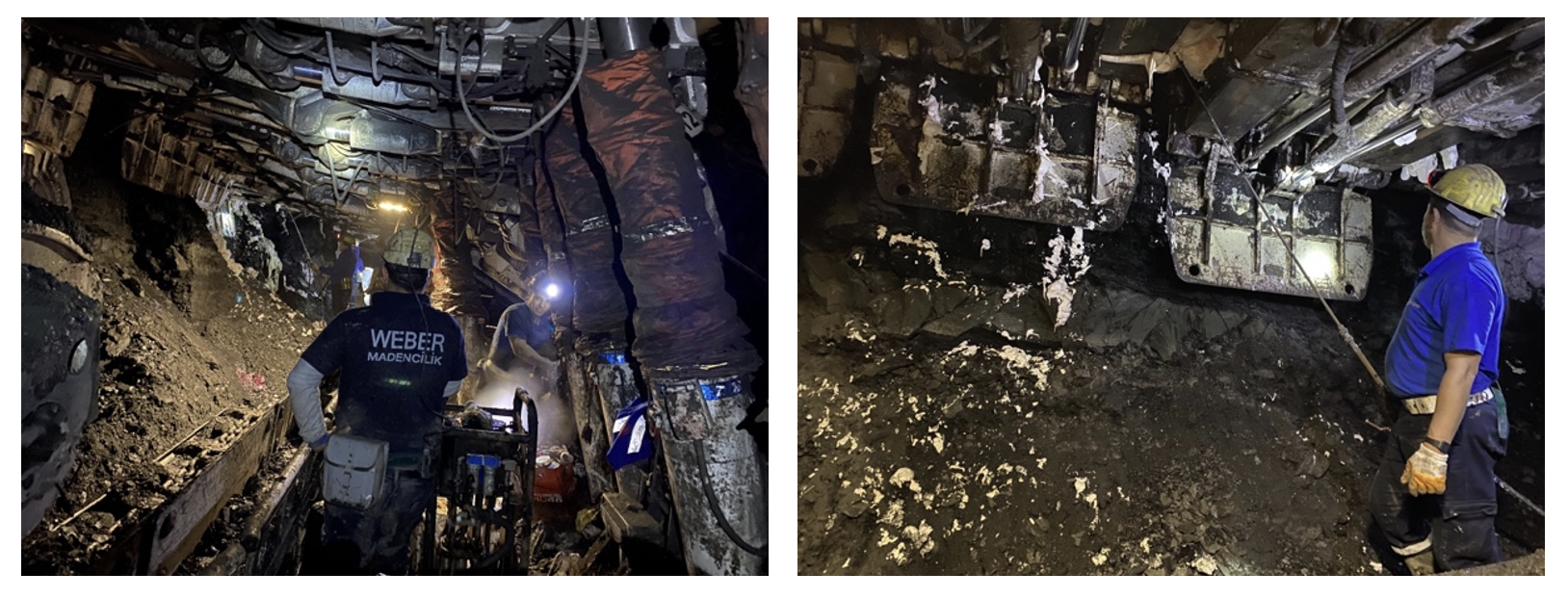
Figure 1: Roof cavity on a longwall face. Left, fallen roof material over the pan line and shield canopies; right, the first foam lifts placed on the rubble pile from the walkway.
2. Why conventional recovery is slow
The historical answers to a large cavity all share the same weakness: they put people and time in the wrong place. Timber cribs and chocks built on the canopies require men working under unsupported ground and only support the roof where the timber touches it. Mesh and bolting from inside the void has the same exposure problem and does nothing about the loose material already on the AFC. Cementitious grouts and concretes can fill a void, but they need leak-tight formwork before a single litre is pumped, they set over hours rather than minutes, and their mass is a liability: a cured cement fill at 1.8–2.2 t/m³ places hundreds of tonnes of dead load on canopies that are already at the limit of their setting capacity. The alternative of simply walking the shields through the cavity accepts a sequence of further falls and a prolonged period of face operation without confinement.
What the recovery actually needs is a material that can be delivered from a protected position, that fills the entire void including its irregular upper reaches without formwork, that reaches a usable state in minutes, and that weighs almost nothing. That is a description of an expansive phenolic foam.
3. What the material is
ROCSIL® FOAM is a two-component phenolic foam. The two are pumped separately and combined at a volume ratio of 4:1 in a mixing gun at the point of application. Expansion begins immediately on mixing, the reaction is complete in 1 to 1.5 minutes at 20 °C, and the product expands to 35 times its initial liquid volume before setting hard. Because mixing occurs at the gun rather than in the pump, there is no reaction in the hoses and the application rate is limited only by pump capacity, up to 60 m³ of foam per hour.
Two properties matter beyond the mechanical figures. The product carries an M1 reaction-to-fire classification (the French NF P 92-507 scale, where M0 is incombustible and M1 is non-flammable), and it is formulated to be antistatic. Both are the reason phenolic, rather than polyurethane, chemistry is used for this duty in coal mines, and both are discussed in section 7.
4. The mechanics of the fix: confinement, not strength
A compressive strength of 30–60 kPa is low in absolute terms, and it would be a mistake to present the foam as a structural member that carries the roof. It does not, and it does not need to. A cavity fill performs five distinct functions, none of which depends on the foam's strength in the way a crib or a concrete pack does.
1. Complete void filling. Because expansion starts immediately and the foam rises to the roof and ribs under its own reaction pressure, the fill reaches the irregular upper parts of the cavity that no formed pour can reach. Broken blocks and slabs in the void are embedded and can no longer rotate, slide or fall.
2. Confinement pressure. The in-situ expansion applies a positive pressure to the fractured roof during the rise, pre-loading the rubble against the cavity walls and reducing the likelihood of further falls onto the AFC and the face.
3. Restored canopy contact. Once the void is filled, the shields have a continuous bearing medium above them. When they are set, load is transmitted through the foam mass to the ground above, and the shields regain their function of confining the immediate roof and controlling the face.
4. Controlled deformation. The foam crushes progressively rather than fracturing. A fill that yields as the strata converge maintains contact instead of failing abruptly, which is what a brittle, high-strength pack would do under the same movement.
5. Negligible dead load. At 25–40 kg/m³, a 200 m³ fill weighs 5–8 t distributed across the affected shields. The rock that occupied the same void, at roughly 2.5 t/m³, weighed around 500 t. A cement fill of the same volume would weigh 350–450 t.
A further practical benefit arises during shield advance. Large rock lumps sitting on the canopies are held by the foam mass and are pushed back towards the goaf as the shields move forward, instead of travelling with the shield and dropping onto the AFC during recovery. This is one of the more common causes of injury and equipment damage in a cavity recovery, and the fill removes it.
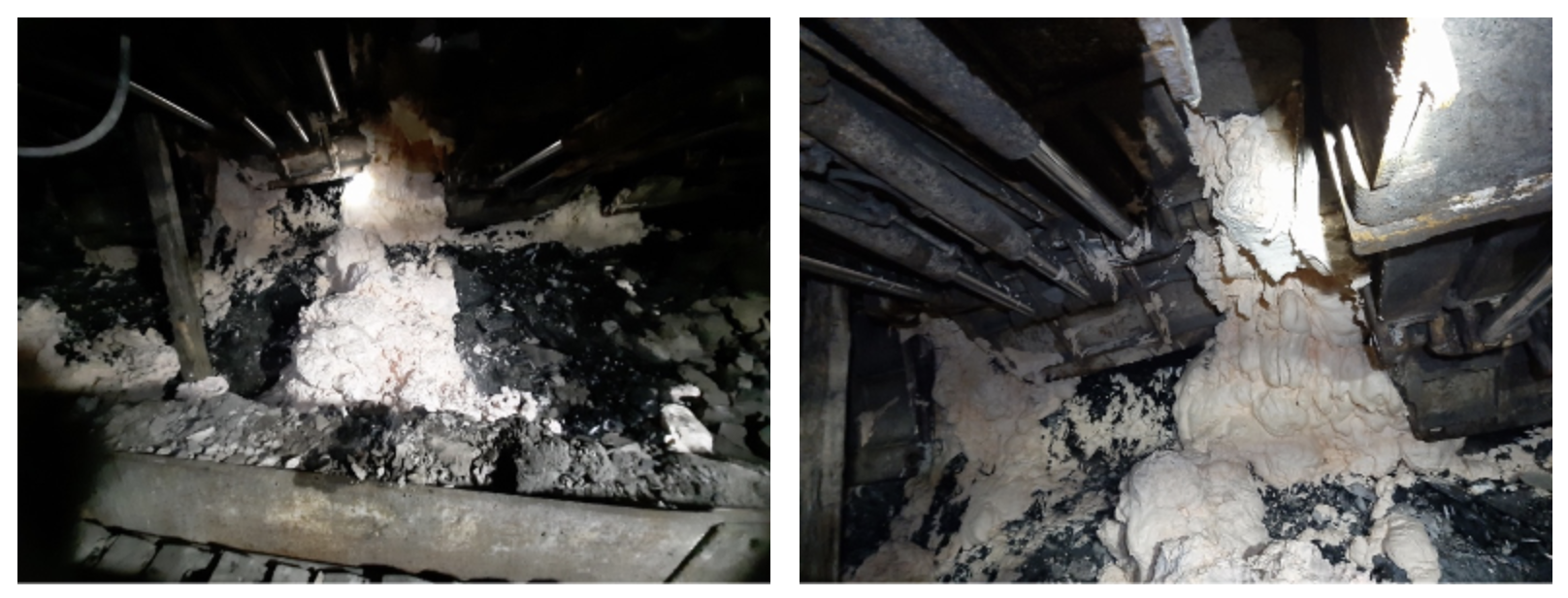
Figure 2: Cavity filled with ROCSIL® FOAM above the shield canopies. The foam has risen to roof contact, embedded the broken ground and re-established a bearing surface for the shields.
5. Application sequence
The procedure is short, but each step has a technical reason behind it.
1. Cavity survey. The extent of the void is measured from the shield tips and, where possible, by camera or laser through the gaps between canopies. The purpose is to estimate volume, identify the highest point of the cavity and any chimney that will trap air, and select the injection points.
2. Contain the pan line. A light barrier is placed at the canopy tips so that foam does not spill onto the AFC. This is not structural formwork; the foam's instant expansion and rapid set mean it supports itself on sloping rubble, and a leak-proof shutter is not required.
3. Set up from a protected position. The two-component pump is positioned in the gate road or several shields away from the fall. Component A and component B are fed through separate hoses to the mixing gun, which is introduced through the gap between canopies or from the side of the void. The operator remains under supported roof throughout.
4. Inject from the lowest point upwards, in lifts. Each lift rises immediately, sets within 1–1.5 minutes and becomes the platform for the next. The sequence works towards the highest point of the cavity last, so that air is displaced rather than trapped.
5. Monitor and top off. The rise is observed continuously. The fill is complete when the foam is in contact with the roof and ribs over the full extent of the void; over-pumping into a closed volume serves no purpose and is avoided.
6. Advance and recover. Shields are set against the foam pack and advanced. The foam on the face side is easily cut by the shearer, and the pack above the canopies compresses progressively as the face returns to its normal cycle.
6. The arithmetic of a recovery
Take an illustrative cavity 10 m along the face, 4 m into the face and 5 m high, which after allowing for the irregular shape and the rubble already in the void is on the order of 200 m³ to fill.
• At an expansion ratio of 30–50, 200 m³ of foam requires 4–6.7 m³ of liquid product, of which four fifths is component A and one fifth component B. In practical terms this is a handful of drums brought to the face, not a train of material.
• At an application rate of up to 60 m³/h, the fill itself takes roughly three and a half hours of pumping. Site set-up and survey add to this, but the confinement of the void is established within one shift.
• The equivalent cementitious fill would require 350–450 t of material to be transported underground and placed, plus the time to build formwork and wait for set. Cement cannot in any case be placed against the roof of an open void without pressure grouting.
The commercial consequence follows from the production loss. A longwall face is a single point of failure for a mine's output, and the cost of the recovery is dominated by the hours the face is stopped, not by the materials used. Speed of application is therefore a geotechnical and a financial variable at the same time.
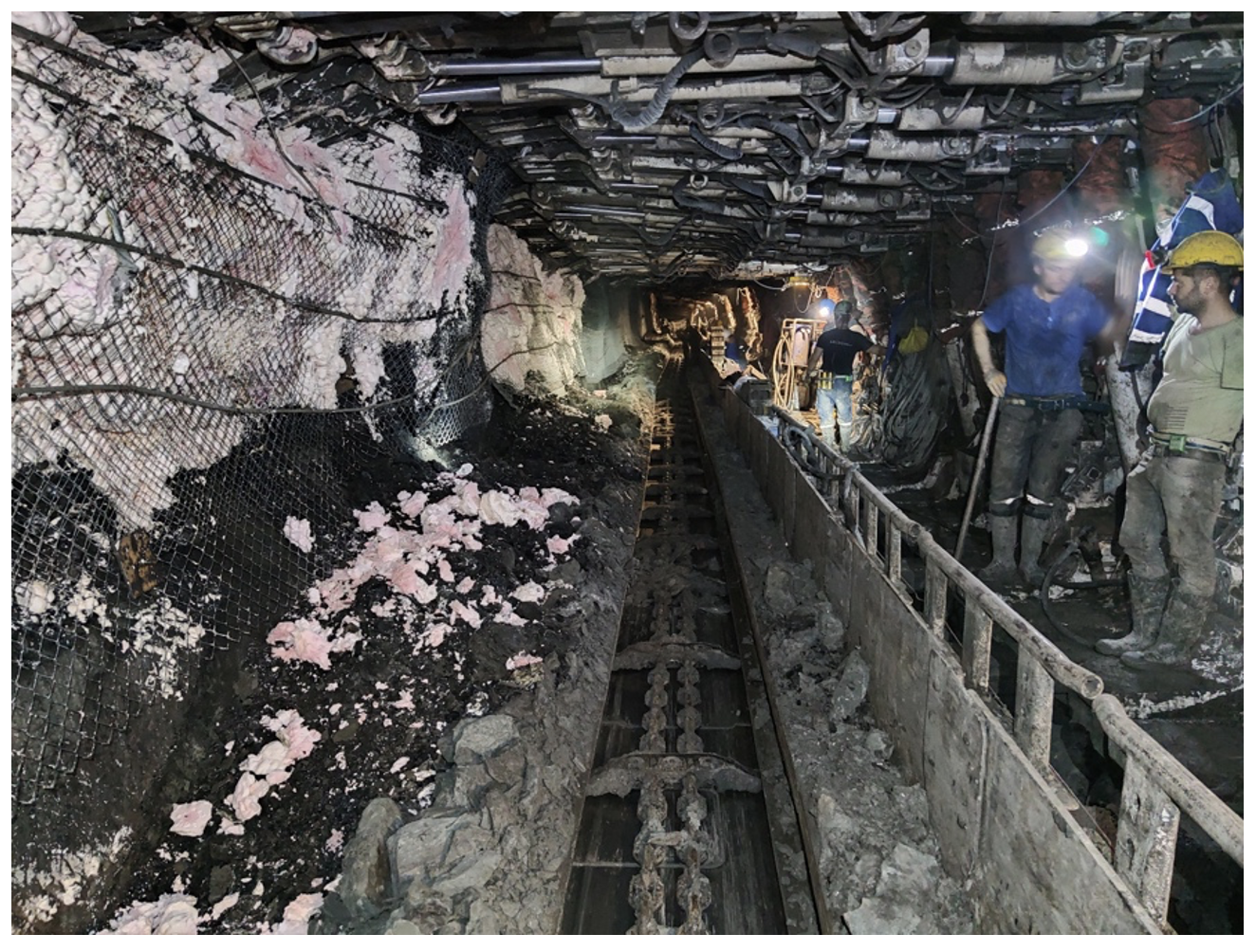
Figure 3: Face recovery after foam filling. Mesh and foam pack along the face; the shields are being advanced under a confined roof.
7. Fire, gas and static electricity: why phenolic and not polyurethane
Any material placed in bulk above a longwall in a gassy coal mine has to be judged on its behaviour in a fire as well as under load. Polyurethane foams offer higher expansion and higher strength, and they have been used underground, but they are combustible unless heavily flame-retarded, they generate a strong exotherm when reacted in large masses, and they have been implicated in underground fire incidents; several coal jurisdictions restrict or prohibit them for this reason. Phenolic foam behaves differently. The cured resin is char-forming, it does not propagate flame, and it produces little smoke. The M1 classification reflects this, and it is the property that makes the same product suitable for the injection of firewalls, for sealing off heatings and for supporting firefighting operations.
Two further aspects are specific to the longwall environment. First, a cavity above the shields is in direct communication with the goaf. A foam fill that is in continuous contact with the roof and ribs limits the air path into the caved zone behind the face, and therefore the oxygen available to the broken coal in the goaf where spontaneous combustion starts. Second, the product is antistatic. Pumping a resin at high rate through hoses and a gun in a methane-bearing atmosphere is an electrostatic hazard in its own right, and a foam that does not accumulate charge removes it.
8. The same chemistry beyond the face: remote sealing
The properties that make the foam effective in a cavity, immediate expansion to the roof and ribs, rapid set, airtightness and fire resistance, are the same ones required of a ventilation control structure, and the product is used for that purpose as well. When a fire or heating makes a district inaccessible, a foam plug can be pumped from the surface through a borehole to an injection head and hoses pre-installed in the roof of a roadway, isolating the zone without anyone entering it. A borehole camera confirms the plug has closed to the roof. The plug is then backed with conventional stoppings or explosion-rated seals, and it can be removed once the event is over to allow safe re-entry.
9. Conclusion
A longwall cavity is a problem of lost confinement, time-dependent deterioration and exposure of people under unsupported ground. Phenolic foam is the appropriate answer because it acts on each of those three: it re-establishes confinement and canopy contact in minutes rather than hours, it does so from a protected position without formwork, and it adds practically no load to shields. The M1 fire classification and antistatic formulation are what make the chemistry acceptable above a coal face, and they are also what extend the same system to firewalls, heating seals and remote ventilation plugs. Judged on the mechanics and on the arithmetic of face downtime, cavity filling with phenolic foam is not an incremental improvement on cribbing and grouting; it is a different class of solution.